If you follow myself and other health professionals on X, there’s a good chance you’ve been made aware of what’s being called the ‘Sniderman paper.’ Published in the European Journal of Preventive Cardiology, this study on the ‘Interplay of HDL cholesterol and apolipoprotein(apoB) and the risk of incident atherosclerotic cardiovascular disease in UK Biobank’ has caused quite a stir in online spaces.
These findings help shed new understanding of the interaction of HDL and heart disease, and for some people, it’s completely reshaping how they look at metabolic heart health. So I wanted to use the opportunity to talk about one of the most important factors it discusses: your HDL-C and how it may help reduce your risks of a heart attack.
Article overview
- High-density lipoprotein cholesterol (HDL-C) is considered a ‘good’ cholesterol in that it helps eliminate ‘bad’ cholesterol from your body, which can aid in lowering your risks of heart disease and heart attacks. One of the proposed hypotheses in the paper is that HDL may be effective because of its ability to limit apoB’s action in the body.
- There are several ways to naturally increase your body’s HDL levels, including diet and exercise.
- Synthetic HDL boosters exist, but it’s better to try to maximize your HDL levels via the use of natural mechanisms first.
The relationship between heart health risk and HDL-C
There are plenty of breakdowns related to Sniderman’s paper, so I won’t belabor the point here. But to summarize: it sheds new light on how high-density lipoprotein interacts with apolipoprotein (apoB), which is a major contributor to increased risk of atherosclerotic cardiovascular disease.
Sniderman’s conclusion reads: “High HDL-C is associated with lower ASCVD risk, independent of apoB, and it attenuates (read: reduces) the effect of high apoB on ASCVD risk. These findings suggest HDL-C’s role in primary ASCVD prevention warrants re-evaluation.”
This statement reveals to us two things. First, that apoB scores may not necessarily be the end-all-be-all of heart health risk (which I’ve already covered in this dedicated article on apoB). Second, higher HDL-C is linked to lower risk of heart disease.
But what exactly is HDL-C? Essentially, it’s your ‘good’ cholesterol, as you’ve likely heard from most doctors. These molecules pick up your LDL cholesterol and whisk those particles away to be removed by the body via the liver. So it stands to reason that having more HDL than LDL can be cardioprotective in most circumstances.
Sniderman’s research suggests that, among other things, having higher HDL may help to prevent the worst effects of a high apoB. But more research will be needed.
In the interim, though, you should know that HDL-C scores are easily improved in most Americans.
Let’s take a closer look at the steps below.
How to improve your HDL-C
The higher your HDL-C score, the better, but what’s the best way to go about increasing yours?
I recommend starting in three areas:
Benchmark first
The best way to begin improving any of your biomarkers is to carefully benchmark where you are right now. That way, you can make more informed decisions about the best next step for your health, as well as how far you are from the goal.
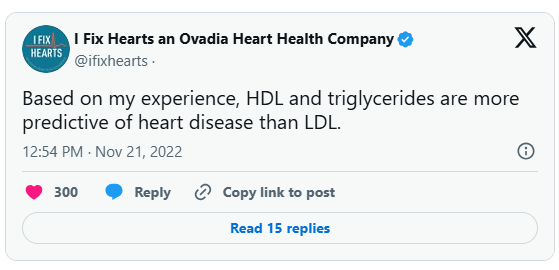
For example, we know from other research that one powerful indicator is the triglyceride/HDL ratio (commonly styled TG/HDL-C ratio). This measures the balance between your triglycerides (which can be elevated by excess carbohydrates, alcohol, and insulin resistance) and HDL cholesterol (which can be reduced by things like inactivity, insulin resistance, and smoking).
You can calculate your TG/HDL ratio by dividing your total triglycerides by your HDL number, using the same mg/dL units, unless your lab work has already done this for you.
Again, keep in mind your TG/HDL ratio can help predict heart health risks better than LDL-C alone, so getting an understanding of what your numbers are first is a great way to begin your journey.
Learn more about the most accurate measures of heart disease risk.
Adopt a low-carb diet
Studies show that very low carbohydrate diets can help reduce triglycerides by as much as 30%, while increasing your HDL-C by as much as 30%. Even if your current ratio isn’t ‘optimal’ by existing standards, trying a low-carb, ketogenic, or even carnivore diet can work wonders in ‘righting the ship’ with your TG/HDL-C ratio.
Learn more about changing biomarkers on ketogenic diets here.
Build metabolically healthy muscle
The more muscle you have, the more energy you use at rest, and the more cardioprotective benefits you may have. Case in point: skeletal muscle mass was found to be a major predictor of higher HDL-C. It can also decrease the ratio of LDL-C to HDL-C, which may contribute to a longer healthspan as well.
The good news is that you don’t need multiple hours in the gym to start building metabolically healthy muscle. Simple resistance exercises, consistently adhered to over the course of 12 to 16 weeks, can have noticeable benefits on both your blood work and body composition.
Don’t have access to a gym? Even cardiometabolic exercises can benefit your HDL-C. Jogging, for example, is linked with lower blood pressure and higher HDL levels. It also happens to be a great exercise that doesn’t require a gym membership. If you’re not quite up to jogging, fast walking is also excellent.
Learn more about the best exercises to strengthen your heart.
A note on synthetic HDL-C boosters
In all this discussion on boosting your HDL-C, you may have noticed the conspicuous absence of medications or synthetic HDL-C treatments. These, as you may have guessed, are an option for treating low HDL-C. However, studies show little cardiometabolic benefit in using HDL-C medications to increase serum levels in the blood and there’s little evidence to suggest that they improve heart attack rates.
Frankly, artificial HDL-C medicines may not necessarily be the best investment for your heart. And maximizing your natural HDL-C-boosting approaches first is always a good idea.
This is a potentially important finding as we consider the Sniderman paper: if the drugs raised HDL-C but didn’t show a cardiometabolic benefit, then the number itself might not be what’s protective. Rather, the protection might be coming from the behaviors that drive the number.
That’s exactly why diet, exercise, and building muscle are the better investment: they improve metabolic health broadly, with HDL-C as one signal among several, rather than moving a single number in isolation.
Again, food is medicine, especially for the heart.
Reducing your cardiovascular risk long into the future
The Sniderman paper may have brought the HDL-C conversation to the forefront, but this is by no means an incredibly revelatory finding. Many of the steps taken to improve your HDL-C, like eating whole, real foods and building muscle, are also heavily correlated with having a better, longer lifespan in general (as well as better heart health).
Again, I want to mention that supporting your HDL-C should be just one small part of your overall heart health regimen. There are many other ‘formulas’ worth checking for your health, like how much protein you eat and your resting heart rate.
Below are a few other biomarkers worth checking for your metabolic health: