I read and get tagged in heart health-related social media posts all the time these days. Many of them qualify as excellent advice. Others… perhaps not so much.
This isn’t always for malicious reasons. Can you imagine how much bad advice I dished out when I was a fat heart surgeon parroting the advice to eat less and move more?
Even so, I still feel compelled to set the record straight so you feel more confident about making the right decisions for your health.
A quick note before we begin
I might be a little harsh in this roundup, but it’s by no means to criticize any singular person. I’m not interested in ad hominems or red herrings, but I will attack false ideas or misconstrued information.
Because once upon a time, I wish someone would have given me a similar wake-up call. If I can use this to provide much-needed education, or at least keep the conversation going, then I’ve accomplished my goal.
With all this in mind, let’s look at the posts.
The necessity of GLP-1

For the unfamiliar, GLP-1 agonists are a type of medication originally designed to help diabetics manage their glucose. They’re now recognized as one of the fastest-selling weight loss drugs of all time, with one in eight US adults having tried the medication at least once.
Many doctors (including that one) call GLP-1 agonists a miracle drug, since it can lead to weight loss without dieting or exercising. But is it really the only treatment available for overweight or obese patients?
Yes, you’ll certainly lose weight on GLP-1 agonists, but the benefits may slow after the first year. And if you don’t adjust your eating pattern, exercise habits, or other lifestyle factors, you may be on a $1,000+ monthly prescription for the rest of your life.
I actually agree with the Redditor here: traditional diet and exercise advice is not the solution. And there are people who will live longer by taking GLP-1. But that doesn’t mean it’s suitable as a widespread drug for losing weight. What’s needed is a new angle for nutrition and metabolic health, not just “eat less move more” or “calories in calories out.”
It’s important to remember that medication isn’t a requirement to reverse chronic disease like obesity. And saying that “diet and exercise aren’t effective for weight loss” is missing the point. Because yes, you can lose weight on Ozempic, but being thin does not always equal being healthy.
The goal should be to restore your metabolic health first, which typically results in better heart health and weight loss as happy side effects.
To be clear, I know how difficult it can be to gain habit momentum in the early days of weight loss. So I recommend taking a holistic approach — if you feel you must have a GLP-1 agonist, don’t use it in a vacuum. And of course, take time to weigh the risks and benefits so you can make the best decision for your metabolic health.
I wrote a guide covering GLP-1 agonists in greater detail if you’re curious about learning more.
Sugar and carbs don’t cause diabetes
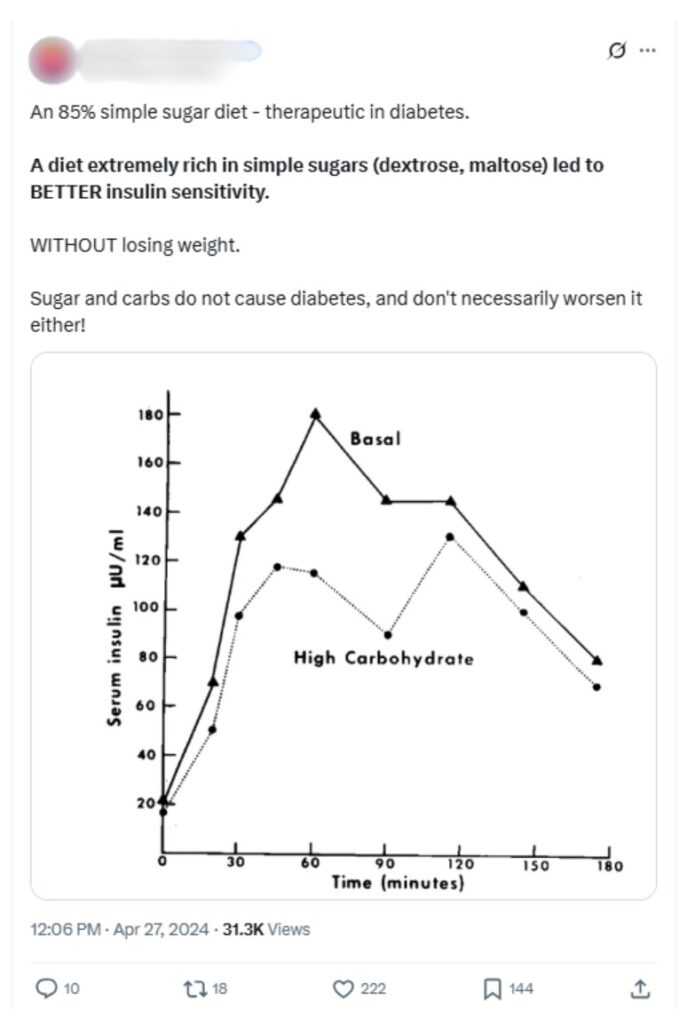
First, some context. You can find the referenced study at Improved Glucose Tolerance with High Carbohydrate Feeding in Mild Diabetes.
Now, to get into the weeds. Because this is a very misleading title, followed by quite a lot of misleading information.
First, the study itself was published in 1971 (read: 50+ years ago). The study didn’t just focus on diabetic patients — instead, a combination of “patients with mild diabetes” and “normal subjects.”
Patients were fed a mixture of dextrose and maltose, not fructose or sucrose, which are far more common in natural settings.
And keep in mind the study lasted 10 days only. That’s hardly the period required to see meaningful changes, considering it takes “mild diabetics” such as prediabetics anywhere from three to six years to develop a type 2 diagnosis.
Now, to look at more modern research. Because contrary to what’s being posited here, sugar and carbs do play a major role in causing and worsening diabetes.
The highlights:
- High-sugar diets accelerate high blood pressure (hypertension)
- High-carb diets may worsen hypoglycemia and increase insulin requirements over time
- Eating ~70% of your daily calories as carbs may put you at risk for type 2 diabetes
And the kicker: a high-carb diet may contribute to atherosclerosis and vascular disease, both of which can ultimately lead to early death.
This post is vaguely reminiscent of the recent buzz surrounding the sugar diet, which is a fad that uses CICO alongside a highly processed diet to ‘help’ people lose weight. In both cases, the hypotheses are missing the point: the repeated consumption of metabolically harmful substances could have devastating effects on your downstream heart health.
Meat is bad for you

I’m a heart surgeon who follows a carnivore diet. So no, not every cardiologist will tell you red meat is bad.
As I’ve seen time and time again with my patients, it’s an incredible catalyst for good. Red meat is actually one of the healthiest foods you can eat to restore and protect your metabolic health.
Here’s why:
- Red meat offers highly bioavailable nutrients such as protein, iron, and vitamin B12
- This highly available protein can help to build muscle, which is far more metabolically active than fat
- Low carb diets may improve insulin sensitivity and reduce blood sugar spikes leading to poorer metabolic health
After 6+ years of following a mostly carnivore diet, I can tell you that my CAC score remains a very healthy zero.
I’ve even seen a patient’s CAC score decrease 17% in one year simply by eating whole, real food like animal-based protein.
You can learn more about the best meat to eat for your metabolic health here.

Plant-based diets for children

Just like adults, children need metabolically healthy diets. But decades of research prove veganism may not be one of them.
Contrary to what you might find on platforms like Facebook, vegan diets for children can:
- Restrict growth and result in shorter overall height
- Result in malnutrition due to low volumes of vitamin B12, DHA, iron, vitamin D, and calcium
- Cause brittle bones, which are at a higher risk of fractures
And these are just some of the many unspoken problems of vegan diets.
I am absolutely an advocate of feeding whole, real foods to children. And if you’re a health-conscious parent, I applaud you for going the extra mile.
But avoiding the much-needed, bioavailable nutrients in seafood, eggs, dairy, and animal protein could be fundamentally destructive during your children’s formative years.
I realize there’s quite a lot of buzz around this topic, so feel free to explore more research than I have listed here. Above all, be careful where you get your health advice from, especially when it comes to the health of your children.
Sorting fact from fiction about metabolic health
Social media is a powerful tool for educating people about their metabolic health.
But it can also be a tool for misinformation — something that requires all of us to solve.
As much as we’ve covered here, we’ve barely scratched the surface. There’s an iceberg of half truths and strange misconceptions about health out there.
So if you’re interested in learning more about telling truth from fiction, one of the following may be of interest to you: