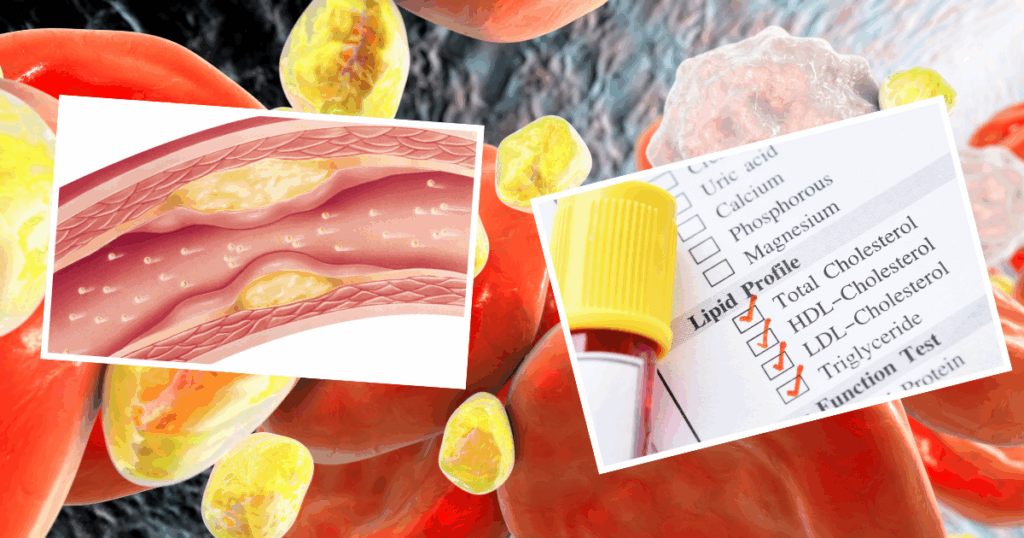
We’ve been taught for years that cardiovascular risk boils down to high cholesterol levels (specifically LDL). I believed this too in the early days of my career — until studies showed that 75% of those hospitalized for heart attacks didn’t have dangerously high LDL cholesterol levels and I noticed an increasing percentage of the patients that I was operating on had low LDL cholesterol levels.
The medical industry has slowly realized that heart disease is more complex than just your number of lipoproteins. For example, particle size and ratio are far more important, and are a much stronger indicator of heart disease than basic lipid tests.
This guide explains how LDL particle size and percentage can better predict cardiovascular risk than traditional methods. You’ll also learn how these markers differ in metabolically healthy people versus those struggling with metabolic syndrome.
LDL particle size and pattern classification
First, let’s take a step back.
Low-density lipoprotein (LDL), often called ‘bad cholesterol,’ varies in particle size and number.
Broadly, there are two different types: large and buoyant, and small and dense.
These different LDL sizes coexist in different patterns depending on diet and health conditions (which we’ll cover later). There are two classifications: LDL Pattern A, which indicates predominantly larger LDL particles, and Pattern B, which indicates mostly small, dense LDL.
Multiple studies have shown that having predominantly small LDL (Pattern B) is associated with much higher cardiovascular risk. For example:
- Men with LDL Pattern B have been noted to have a 3.4-fold higher risk of coronary artery disease compared to those with Pattern A – even after controlling for total cholesterol and HDL levels
- Small dense LDL was linked to a three-fold increase in cardiovascular risk relative to larger LDL in a metabolic syndrome context.
So why are small LDL particles more dangerous than larger particles? Because these particles are more likely to be damaged (ie oxidized) and when they cross the endothelial barrier they stimulate an inflammatory reaction.
You should also know these associations hold at any given LDL-C level. If two individuals have the same LDL cholesterol concentration, the one with predominantly small LDL particles will have greater atherosclerotic risk than the one with larger LDL particles.
This means even if you’re currently at a ‘healthy’ cholesterol level, your particle ratios may still be putting you at risk.
Do I have too much small dense LDL?
As mentioned earlier, your ratio of large LDL to small LDL is greatly dependent on metabolic health. Studies show metabolically unhealthy populations — so those with insulin resistance, metabolic syndrome, or type 2 diabetes — are more likely to have atherogenic dyslipidemia, or a predominance of small LDL particles).
In one study of middle-aged adults, those with metabolic syndrome had nearly three times the percent of small LDL particles compared to those without (32% vs 11%) .
So how do you know if you’re at risk? One of the fastest ways to check is with my free metabolic health quiz.
In a nutshell, you should be on the lookout for:
- Insulin resistance: Insulin resistance is the primary influencer of your LDL particle size and patterns. In a cohort of Korean adults, researchers found that a predominance of small dense LDL distinguished metabolically unhealthy overweight individuals from their metabolically healthy overweight peers. In other words, those who were insulin resistant had more small LDL, whereas metabolically healthy individuals tended to have larger LDL — even at a similar BMI.
- Diabetes: Here, one often expects small dense LDL as diabetes itself is a precursor to metabolic disease. This is true of both type 1 and type 2. Case in point, a South Korean study found type 2 diabetics averaged ~21% small LDL versus ~6% in non-diabetics.
- High triglycerides: High triglycerides over or equal to 200 mg/dL often produce small LDL. You can also measure your triglyceride to HDL ratio, which should be below 2.5.
- Statin prescriptions: In patients with established heart disease or on aggressive statin therapy, you’re likely already suffering from high LDL-C. Studies show that statin therapy “does not decrease the proportion of small, dense LDL among total LDL particles, but in fact increases it, while predictably reducing total LDL cholesterol.” In other words, you may be making your situation worse and putting yourself at risk for both heart and brain diseases.
Want a more ‘scientific’ way of measuring lipids? Another test is something called a NMR lipoprotein analysis. This was designed to quantify your actual concentration of small LDL particles and express them as a percentage of total LDL particles.
For example, your NMR LipoProfile might report small LDL-P, or the number of small LDL particles (nmol/L) compared to your total LDL particle count. You can use this to monitor gradations of particle distribution more precisely than just the binary patterns of A or B.
NMR tests make it easier to detect risks that might otherwise be missed by looking only at average size only. For example, studies show having more than 30% small LDL particles may be associated with a higher instance of coronary heart disease. That means even if most of your cholesterol particles are large, you still have enough smaller particles to put you at risk for heart disease.
By now you might be concerned that you’re at risk for potential disease. The good news is, small LDL is somewhat a modifiable risk marker.
How to reduce small dense LDL
Not all of this is what you’d call ‘conventional’ advice. But I’m pulling straight from case studies and research so you can see for yourself.
According to research, you can reduce small dense LDL by:
- Eat more saturated fat. You’ve likely been told that saturated fat is the ‘root cause’ of heart disease, but research indicates this may be an oversimplification. Studies have found that saturated fat “increases large, buoyant LDL and/or decreases small, dense LDL particles,” which may reduce your risk for heart disease.
- Follow a low-carb diet. In one dietary trial, adopting a low-carbohydrate diet reduced the percentage of small LDL particles and increased the proportion of larger LDL. This counterintuitively improved the subject’s LDL profile, even if their LDL-C didn’t fall. If you’re interested in this style of diet, you might want to explore keto, carnivore, or something in between.
- Try intermittent fasting. Setting up a regular eating window can help to improve insulin sensitivity over time. For example, alternate-day fasting can improve insulin sensitivity, which shifts your LDL subclass pattern by increasing your cholesterol particle size.
- Lose fat and increase muscle. This typically begins with exercise and resistance training. There’s a great deal of evidence suggesting that obese individuals can shift from pattern B to A by losing unnecessary adipose tissue (aka fat).
The take-home message I want you to have is that not all LDL is created equal. Knowing particle size distribution can help you better understand your heart health risk factors and double-down your focus on reversing poor metabolic health.
Wondering how to get started along your metabolic health journey? I explain the process in detail in how to improve your metabolic health in 12 weeks or less.