
I’ve written extensively about the dangers of fake sugar. Now, I need to draw your attention to another ‘frankenfood’: esterified propoxylated glycerol (EPG), which is artificial fat.
Despite claims of being healthier than traditional fats, EPG isn’t the miracle food it’s made out to be.
Here’s everything we know about alternative fats and how they affect your metabolic health.
First, a brief overview
EPG is quickly capturing interest as a low-fat, low-calorie food additive. It’s solid at room temperature, but is not a saturated fat or triglyceride. There’s also little to no nutritive value — it’s been designed to have about 92% less calories.
Here’s a quick breakdown on how EPG is made:
- Canola oil is broken down into its fatty acid tails
- Then, food scientists take a multi-step chemical process involving propylene oxide
- The resulting product has the texture of warm candle wax and has almost no calories compared to real fat
The result is a non-digestible, ‘plant-based’ alternative fat that supposedly feels and tastes like the real thing. You can imagine the implications: a low-calorie additive in processed foods, which could help reduce fat intake for consumers following the US food pyramid.
This isn’t the first time scientists have tried to make artificial fat. A predecessor, Olestra, was approved by the FDA as a food additive in 1996. It quickly lost steam — unsurprising, considering that one of its side effects was “anal leakage” — so you won’t find it on the shelves anywhere today. In 2009, Procter & Gamble turned it into an additive for paints and lubricants (a scary thought for those who were originally consuming it).
EPG claims to be a better alternative to Olestra, and the FDA has classified it as ‘Generally Regarded As Safe’ (or GRAS).
But that doesn’t mean there aren’t potential issues, as we explore below.
So why am I not excited about EPG?
You’re probably familiar with the myth that eating fat will cause heart disease, so you might think a heart surgeon would be excited for a ‘heart-healthy’ fat replacement.
Except, I’m not quite convinced EPG will make us healthier at all.
Here’s why I’m not thrilled about artificial fat:
History of gastrointestinal issues
Studies show that EPG can cause major side effects, including GI issues. You don’t need to look very far online to see countless reviews warning consumers to stay away.
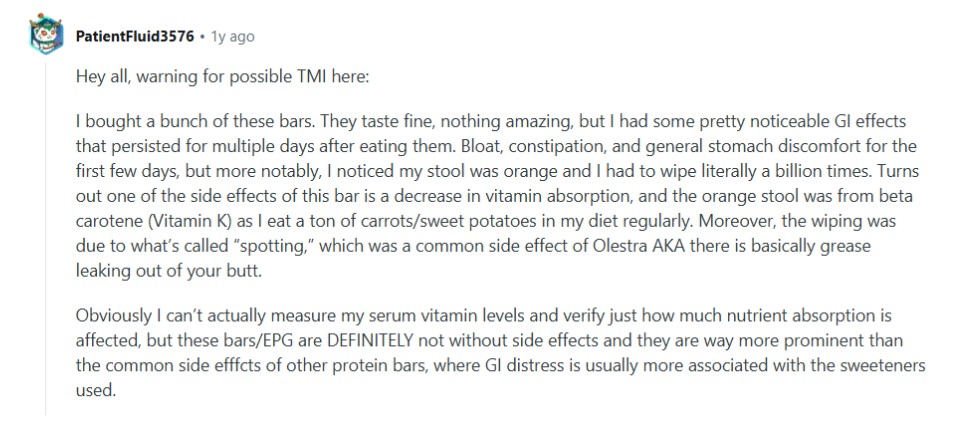
Case in point, let’s look at a certain protein bar company that uses EPG to create low-fat, low-calorie, high-protein snacks. The company warns about GI side effects directly on its website. However, some consumers have alleged more serious side effects:
- Changes in blood work
- Stomach pain, including cramping
- Pancreatitis, or inflammation of the pancreas
- Steatorrhea, or excess fat in waste
- Keriorrhea, or orange waste caused by certain indigestible wax esters
See for yourself:
Some customers have needed more drastic care:

This, as you might imagine, has serious implications for those with IBS, autoimmune conditions, and other chronic gastrointestinal concerns.
It also shows, yet again, the superiority of whole, real food. You’re not likely to experience these unhappy side effects when eating high-protein foods containing saturated fat, like steak for example.
Limited data
EPG is an incredibly new substance with very young data and research available.
We also don’t know how it will affect the body long-term. For example, we know humans cannot digest EPG, but we don’t know its implications on oxidization, or whether or not it can congeal inside the digestive tract.
It will be interesting to see the data five, 10, or even 20 years from now.
But similar to GLP-1 agonists, these substances are simply too young for us to make informed decisions. It reminds me of drugs like statins, where their long-term side effects are only now becoming obvious.
Limited nutritive value
We’re well aware of the dangers of a low-fat diet. So it stands to reason that a diet substituting all fats with EPG could lead to nutrient deficiencies, despite guidance suggesting you could eat up to 150g per day without drawbacks.
Case in point: research shows that EPG can rob the body of fat-soluble vitamins, including vitamins D, E, K, A, and some carotenoids (which may help protect the body from heart disease).
This could deplete you of the micronutrients needed to be metabolically healthy, which might unbalance your hormones, make you feel constantly hungry, and possibly result in malnourishment.
That’s why foods containing fake fats in the past were fortified with oil-soluble vitamins. Not a good sign for the overall nutritional value of what you’re eating.
Which leads to my next point…
You’re still eating ultra-processed food
My biggest gripe with artificial fat is the food in which it hides.
Sure, you can add it to margarine to lower the calorie count, or hide it in baked goods with suspiciously long ingredient lists to make ‘indulgent’ treats fit your CICO goals. But at the end of the day, you’re still eating ultra-processed food.
If you want high-protein, low-fat, low-calorie food, alternatives like fish, chicken breast, or grass-fed sirloin will do the trick.
I couldn’t say it better than my colleague, Dr. Paul Saladino:
“Eating plenty of nutrient-dense calories is vital for healthy body composition. Avoid processed foods, and eat more unprocessed animal and plant foods, and you will lose weight.”
Wait, are you saying eating fat isn’t bad for your heart?
So long as you’re eating the right kind of fat, yes: it could be extremely beneficial to your metabolic health. It’s certainly much healthier than EPG.
I’d much rather point you toward eating whole, real food — including certain fats — that could actually help to protect your heart.
Those details fall somewhat outside this article’s scope, but I do have other resources that can help you learn more: