With so much conversation surrounding the MAHA movement, the term ‘metabolic health’ is getting more attention than ever. Just look at that 100% popularity score in the US between November 30 and December 6, 2025 on Google Trends:
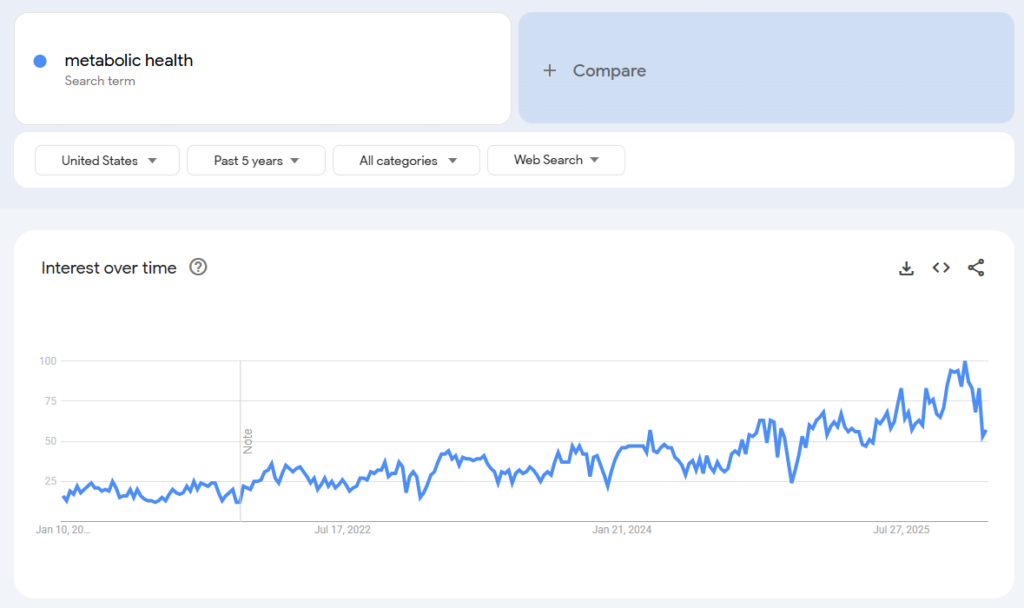
So it stands to reason that in 2026, there are potentially millions of Americans taking an interest in reclaiming metabolic health.
They just need the right resources to get started.
Which is exactly what this guide is intended to do.
P.S., feel free to bookmark this guide so you can reference it later, or share it with anyone you feel could use the information.
What is metabolic health?
Metabolic health measures how well your body handles energy. When it makes and manages enough energy to power your muscles, organs, and other biological processes (like fixing muscle tears), your metabolic system is working as intended.
Unfortunately, this is often the exception rather than the rule.
In 2022, less than 7% of Americans met the criteria for being considered metabolically healthy. In other words, over 90% of Americans are not. Odds are, this could include a spouse, extended family, a good friend, or even you.
People who suffer from poor metabolic health (i.e., cannot create or manage energy efficiently) often struggle with issues like:
- Obesity: Your body receives too much energy from foods without much nutrient density, particularly processed foods like Twinkies. Your body needs to store the excess energy (without nutrients) somewhere else, usually along your waistline.
- Diabetes: For a variety of reasons, your cells may start responding less to insulin, which is the hormone responsible for moving sugar out of the bloodstream and into your muscles and organs. Without a proper insulin response, you get chronically elevated blood sugar. This greatly increases your risk for disease, including high blood pressure.
- Heart disease: Energy failing to reach the right places in your body can cause internal stress and damage, which we often call inflammation. This dramatically accelerates plaque buildup, which puts added strain on your heart and circulatory system.
What makes metabolic health even trickier to manage is that it’s somewhat ‘invisible’ compared to other illnesses. You can’t always see signs of ‘good’ or ‘bad’ health externally. Yes, it’s possible to be lean and still struggle with poor metabolic health.
That said, you can certainly ‘see’ the markers of poor function in your blood labs and long-term healthspan. I cover this in detail at the bottom of our guide.
But first, to answer a glaring question:
Why is our metabolic health so at risk?
Metabolic health is overall health. And as more people discover this, the question becomes, “what happened to us?”
This is, in all honesty, a question with many answers. But in my opinion, it boils down to a few simple things.
First, outdated science. We did the best with what we could. But as we learned more about health in a post-industrial world, we realized some of our hypotheses were very, very wrong.
Second, bad science. At least people are more aware of it these days. Nutrition has a legacy of less-than-rigorous research in exchange for some less-than-scrupulous gains. Ansel Key’s deception is one of the most indefensible of these.
Finally, lack of knowledge. You didn’t learn this in school, and frankly, neither did I. Less than 29% of medical schools offer the recommended amount of training on nutrition’s impact on health and disease. So it’s no wonder we’re met with the largely unhelpful, oft-repeated advice of: “eat less, move more.”
This brings us to the edge of 2026. Many of us are still recovering from a history of bad food pyramids, a misplaced low-fat craze, and terrible advice from so-called ‘healthfluencers.’
But with millions of Americans looking to make themselves healthy again, there’s more interest than ever in turning this ship around.
I’ve designed the following section to serve as more of a quickstart guide, complete with several other resources you can click to learn more.
The metabolic health ‘iceberg’

Metabolic health is very much a rabbit hole. Look long enough, and you’ll eventually wind up ‘falling in.’
There’s quite a lot you could connect the dots to — far too much to cover within a single article. So I’ve organized some resources from most to least involved. That way, you can explore each topic at your own pace.
I’ve ordered our list from least to most involved:
Food
- New US dietary guidelines, reviewed by a heart surgeon
- How to eat metabolically healthy with 5 different popular diets
- Is the European diet healthier than the Standard American Diet?
- The problem with snacking
- Is there such a thing as healthy sugar?
Exercise
- Will weight training cause a heart attack?
- You cannot exercise your way to weight loss
- Don’t have time to exercise? 4 ways to strengthen your heart
- How cardiovascular training can increase your lifespan
- The one measurement you’re forgetting for metabolic health
Chronic disease
- Can chronic diseases be cured?
- The ADA’s new guidelines: Can diabetics eat carbs?
- Your nonalcoholic fatty liver disease isn’t a death sentence
- The link between autoimmune disease and heart disease
- The link between low cholesterol and Alzheimer’s disease
Lab work
- How to read your lab work
- The gaps that wearable health tech can’t fill
- Why your blood tests aren’t accurate (and how to fix them)
- What elevated Lp(a) means for your heart
- Changing biomarkers on ketogenic diets
Biology
- How your cellular health affects your metabolic health
- The synergy between omega-6 acid oxidation and poor metabolic health
- Cardiac mast cells and what they mean to your heart
- What we know about lean mass hyper-responders
- Understanding epigenetics and our metabolic health
How to measure your metabolic health in 10 minutes or less
It’s possible to measure your metabolic health at home using a tape measure, a sphygmomanometer/blood pressure machine (which you can often find at your local Walmart), and a recent blood test.
If you haven’t scheduled a blood draw recently, I recommend starting with an advanced lipid panel. You can learn more about the blood labs you should and shouldn’t order in my comprehensive guide.
Next, you should gather up the following numbers:
- Weight and waist circumference
- Blood pressure
- Blood sugar
- Triglycerides
- HDL cholesterol
If you’re on any medications like statins, insulin, or beta blockers, make sure to take note of these. They automatically indicate something is amiss with your metabolic health.
Finally, you can take my free metabolic health quiz to get a better idea of your overall metabolic health. I’ll email your results (and a few suggested guidelines) within 10 minutes or less.