
Estimates suggest that globally, the average adult spends roughly 6 hours and 54 minutes per day looking at phone, computer, tablet, and TV screens. For American teens, That’s a whopping 47 hours and 55 minutes per week — more than the average full-time job.
There are known negatives of excessive screen time, including poorer attention spans. But an overlooked and concerning implication is its impact on heart health. This becomes even more serious when looking at the growing epidemic of heart disease in young people. Case in point: the AHA found that 71% of Americans between the ages of two and 19 had unfavorable cardiometabolic health.
As I’m going to cover below, there’s quite a bit of research correlating the time spent on screens to unhealthy hearts. But if you work in an office, that doesn’t mean you’re doomed to an early death. Placing buffers around screen use can substantially improve your metabolic health.
This article touches on both subjects so you can take action for yourself.
Here’s a five-point summary of everything you should know:
- Studies show that each extra hour of screen time can increase your cardiometabolic score, with heavier consequences the older you are.
- Screen time is specifically linked with metabolic symptoms like high blood pressure, obesity, and insulin resistance.
- This is particularly impactful on younger populations, where just one in three people has favorable heart health.
- Marjan Moghaddam, D.O., recommends adults limit out-of-work screen time to under two hours for best results.
- You can also offset screentime by engaging in heart-healthy activities, such as interspersing exercise or engaging in analog activities.
What science says about screens and your heart
The negative effects of screen time on your heart begin at an early age.
In 2025, eight doctors published a study entitled ‘Screen Time Is Associated With Cardiometabolic and Cardiovascular Disease Risk in Childhood and Adolescence.’ This flagship research analyzed data from more than 1,000 participants involved in the mother-child cohort studies called COPSAC2010 and COPSAC2000.
Their chief priority was calculating discretionary screen time (self-reported by the parents and children) and comparing it to a summarized risk score comprised of the children’s cardiometabolic factors. For context, this included systolic blood pressure, waist circumference, HDL cholesterol, glucose, and triglycerides. They also evaluated ‘secondary outcomes,’ which included markers of insulin resistance, lipoproteins, anthropometry, and inflammation.
The study found that “screen time was positively associated with cardiometabolic and cardiovascular risk, and these associations were stronger among children and adolescents with shorter sleep duration.” Each additional hour raised risks slightly for younger children, and significantly more for adolescents (which includes individuals at age 18). High blood pressure and obesity risks were some of the most common and significant variables.
Note that this study adjusted for other lifestyle factors that might explain its dour results. This included objective measures of:
- Sleep
- Diet quality
- Physical activity
- Pubertal development
Even after these adjustments, the findings were the same: “screen time, whether through phones, televisions, or gaming, consistently demonstrated a positive association with multiple CMR factors.”
You can read the full study in the Journal of the American Heart Health Association.
What makes screen time so bad, then?
Don’t be fooled into thinking screen time is only problematic for younger people. As this independent study covering adults in 2024 explained:
“While research has primarily focused on children and adolescents, demonstrating links between excessive screen time and outcomes like increased BMI, diminished cognitive and language development, decreased academic performance, and altered sleep patterns, there is also growing evidence suggesting that adults are not immune to its ill effects.”
A large part of this is, you guessed it, likely due to screen time.
This is likely true for three reasons.
- Screen activities are (usually) sedentary. Most screens require you to sit down or remain motionless to use, so you’re spending less time moving. Sedentary behavior is directly linked with metabolic dysfunction.
- Screen activities are distracting. Watching something on a screen can significantly distract from feelings of fullness, especially if you snack. You might not need to eat anything at all, but if you associate snacks with your screen, it might be hard to separate the two.
- Screen activities may prevent you from sleeping. This is especially true if you tend to stream movies, play video games, or watch YouTube videos late at night. Studies show it can take hours for your brain to regain a sense of restfulness due to blue light exposure. As a result, screen time can ‘steal’ time from sleep. Not an ideal situation when sleep contributes so much to your cardiometabolic health. This study also mentions the long-term effects of screen time on feeding patterns, which “may contribute to hormonal dysregulation, increased appetite, and weight gain.”
How to address the health effects of prolonged screen time
We live in a world surrounded by screens. So how do we make the choice to avoid them?
You first need to start by taking an honest assessment of your time.
If you’re worried your screen usage is high, I recommend the following steps.
Take a litmus test
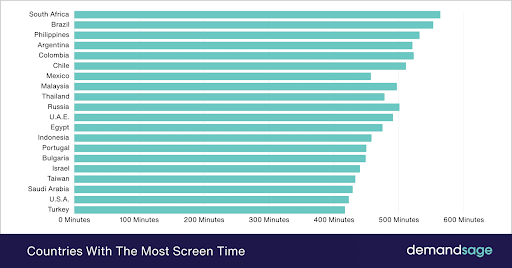
For context, the average American adult spends over 400 minutes on screens per day. That’s nearly 6 hours and 40 minutes of time on digital devices.
If your usage is currently higher than this, it might be time to reevaluate.
There’s no ‘secret sauce’ number necessarily, but many experts, like Dr. Marjan Moghaddam, D.O., recommend under two hours of out-of-work screentime.
With children, ask yourself: are you setting them up for a lifetime of tech literacy? Or, are you creating an environment that produces shiny-light-obsessed couch potatoes?
There are detailed screen time guidelines for children available from the AACAP.
Make screens less accessible
There are all sorts of methods you can employ for this tactic. At the end of the day, I only care about what works best for you.
Some people, like Andrew Huberman, create physical barriers between themselves and their screens. Others use apps and browser extensions designed to ‘time out’ or ‘lock’ apps depending on usage.
Still others may prefer to simply silence notifications, uninstall specific apps, or keep their phone out of sight until specific allotted times.
For children, becoming the role model is one of the easiest ways to show healthy habits. Limit screen time within certain parameters, and be sure to supervise use until an age you feel is appropriate.
The dose makes the poison, as they say. Putting limits on your screen time can make a world of difference for your health.
Make mandatory screen time more metabolically healthy
Let’s say that, adding in work-related tasks, you average approximately 12 hours of screen time per day. You know you can cut a few hours here or there. But you can’t necessarily escape your screen completely. What to do?
Some suggestions:
- Incorporate movement into your screen time. This doesn’t necessarily limit screen time per se, but it does protect your heart health when sitting for prolonged periods. You can also take short breaks between tasks with short exercises that only take a few minutes.
- Pick up some analog hobbies. Exercise is, of course, one of the first recommendations I’d make. But any hobby that works your mind and body is good. Think gardening, hiking, cooking, and so on.
- Try shaking things up. Walking meetings, for example, are increasingly popular. You might also try joining virtual meetings via audio (if allowed) so you can have more freedom to move around. Another option is speech-to-text instead of manually typing individual sentences. Even lunch away from your desk can have a positive impact.
Making a difference starts with you
I’ve had my differences with AHA over the years, but this is one guideline I’ll firmly support. Reducing screen time for both yourself and your children is one of the easiest lifestyle changes that supports long-term heart health.
Remember: advertisers, social media platforms, and marketing companies will spend billions of dollars to keep your attention this year. You are the only one who can make the decision not to.
And, by doing so, will help make America healthy again.