Maybe you’ve been told that heart disease is entirely caused by cholesterol. Or perhaps you’ve read an article pointing the blame at saturated fat. Or you might have heard a doctor say it boils down to bad genetics.
These statements are plastered all over the internet and presented as facts. In traditional medicine, they’re practically gospel. But let me set the record straight: the real drivers of heart disease are not listed above.
I want to take a few minutes to clear up the discrepancy so you can make more informed decisions. Because the sooner you have a better picture of what really causes cardiovascular damage, the faster you can make lifestyle changes to protect your metabolic health.
Article overview
- Contrary to popular belief, heart disease isn’t mainly attributed to genetics, saturated fat, or cholesterol.
- The biggest drivers of heart disease are insulin resistance, inflammation, and metabolic dysfunction.
- All three drivers of heart disease depend heavily on lifestyle, meaning that your diet, exercise, and habits can meaningfully reverse your risk.
What traditional doctors thought caused heart disease
Over the past 200 years of cardiovascular research, we’ve developed a lot of theories around the causes of heart disease.
Some have held up over the years. Many others have been disproven. And that’s how we know, contrary to popular belief, that heart disease is not caused by:
Genetics
It’s true that genetics can play some small role in your heart health. But this is more a matter of nurture than nature.
Heart defects present at birth are thought to affect less than 1% of the US population. But these don’t inherently link to heart disease in the other 99% of the population. In other studies, individuals who did come from high-risk families were able to drop their coronary artery disease risk by 50% through lifestyle factors alone. They lived more than 20 years longer than those who didn’t make changes.
As cardiologist Dr. Stephen Kopecky explains, your genetics account for 20% to 30% of your heart risk at most. The other 70% to 80% is related to lifestyle.
In other words: the food you eat, the exercise you get, and the habits you keep.
Saturated fat
Animal fat has long been the so-called villain of heart disease, thanks to Ancel Keys’ Seven Countries Study in 1958. You’re likely familiar with the study’s findings: that fat consumption and cardiac mortality are linked at the hip.
But what you may not have heard is that subsequent researchers found that Keys’ data was significantly cherry-picked. A re-analysis found that coronary mortality most strongly correlated with sugary foods like pastries, not saturated fat. Thus, dietary recommendations to reduce fat for heart health were “based on weak, associational evidence.” Plus, “subsequent clinical trials attempting to substantiate this hypothesis could never establish a causal link.”
To drive this point home, let’s look at The PURE study, which followed 135,000+ people across 18 countries for nearly a decade. Not only was saturated fat not associated with heart attack risk or cardiovascular mortality, but it was actually linked to a lower risk of stroke.
Cholesterol
The conventional view of cholesterol is that high LDL cholesterol causes heart disease. But in truth, cholesterol is simply part of the repair mechanism for the damage that’s caused by poor metabolic health.
It’s also important to know there are different types of cholesterol. HDL and LDL behave very differently, and the ratio of one to the other has a significant impact on your heart health.
But only fairly recently have we looked more closely at advanced lipid metrics, which put forth a more complicated picture. There are also two types of LDL molecules — small and large — which come from different types of foods and have varying degrees of impact on your heart.
In other words, blaming all cholesterol for heart disease is a bit like blaming headaches on paracetamol.
We’re simply looking at things the wrong way around.
The 3 factors that actually drive heart disease risk
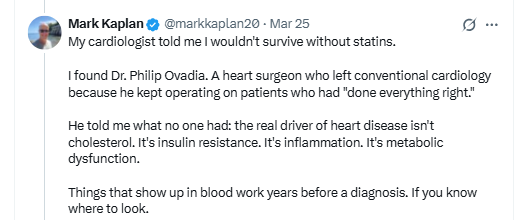
Heart disease risk isn’t necessarily about how high your cholesterol is, or about how long your family history of heart attacks goes.
Contrary to popular belief, research shows it boils down to three major drivers: insulin resistance, inflammation, and metabolic dysfunction.
Insulin resistance
Your body releases insulin in response to food, typically when your blood sugar rises after a meal. When you eat too often, or you spike your blood sugar significantly, your cells stop responding properly to insulin. Thus, insulin resistance.
Insulin resistance contributes to cardiovascular disease in two ways:
- Plaque formation. Insulin resistance significantly disrupts blood vessel function and encourages plaque buildup.
- Ventricular hypertrophy leading to heart failure. In other words, thickening the walls of your heart’s main pumping chamber.
Insulin resistance also results in inflammation, which we’ll cover in the section below.
Learn more about insulin resistance and heart disease.
Inflammation
Inflammation is your body’s natural response to injury or infection, like damage to your heart. And as insulin resistance is a chronic condition, it may keep your immune system in a low-grade state of alarm 24/7/365.
Chronic inflammation continues to damage the inner walls of your blood vessels, which makes them easier for plaque to grab and accumulate.
It also makes existing plaque more likely to rupture, which is what triggers a large amount of sudden heart attacks. No wonder inflammation is now one of the most reliable predictors of future heart disease, often more telling than cholesterol.
Learn more about inflammation and heart disease.
Metabolic dysfunction
Metabolic dysfunction, often referred to as metabolic syndrome, is generally diagnosed by the presence of:
- High blood sugar
- Excess belly fat
- High triglycerides
- Low HDL cholesterol
- High blood pressure
If three or more of these are present, you are likely metabolically dysfunctional.
Each of these conditions raises heart disease risk on its own. That said, the combination of high blood sugar, inflammation, and poor lipid balance creates the ideal conditions for plaque to form.
The most concerning element of this is that metabolic syndrome is an ‘invisible’ disease. Considering 93% of Americans are not metabolically healthy, there is a very good chance you already fall into this category.
Learn more about metabolic syndrome and heart disease.
How do I know if I’m facing the drivers of heart disease?
No matter where you are with your metabolic health, I’d advise you to consider getting a baseline sooner rather than later.
This typically starts by getting blood tests for inflammation and insulin resistance (typically A1C and C-peptides). You can order a test online for less than $100, then report to a local lab to have your blood drawn. Apart from lab-based biomarkers, though, keep your eyes peeled for the earliest signs of insulin resistance.
Not sure which tests to pick? You can learn more about the three blood labs I would take, and the three I wouldn’t.
Next, I’d recommend taking my free online metabolic health quiz. This will help you get a better idea of non-blood-related health, including the five factors of metabolic health. I’d also highly recommend considering medical wearables like CGMs to keep an eye on other metabolic health numbers.
Finally, look at all the numbers you’ve collected alongside other accurate metrics for heart disease risk. This includes:
- High-sensitivity C-reactive protein (hs-CRP)
- Coronary artery calcium (CAC) scan
- Apolipoprotein (ApoB)
If you see three or more abnormal numbers, especially abnormalities in your blood pressure, blood sugar, and waist circumference, there’s a very good chance your heart is at risk.
The good news is, there are things you can do to correct course quickly.
How to control the drivers of heart disease
Now that you know what the real ‘boogeymen’ are, it’s time to formulate a plan.
And yes, this might require you to go in a different direction than what a traditional doctor might advise. But making an effort to address these factors now will lead to much better health results down the road.
This includes:
- Limiting lifestyle factors that lead to insulin resistance. That means getting regular exercise and reducing processed foods.
- Reconsidering certain medications. There’s a chance that your medications could be robbing your metabolic health. Statins, for example, can affect your body’s sensitivity to insulin. Other prescriptions, like steroids and blood pressure medications, are similarly linked with insulin resistance. You don’t necessarily need medication to manage chronic disease
- Reining in unhealthy habits. This starts by cutting back on your sugar intake, smoking, and drinking alcohol. You should also establish more routine around things like sleep, which can have a significant impact on your ability to manage blood sugar.
I realize this can be a lot all at once, especially in the early stages of your metabolic health journey.
Rest assured you don’t have to go the distance alone.
You’re welcome to schedule a consult with my team to talk through the specifics.